Ads
Quick installation of sudo:
Step 1: Update system:
sudo apt-get update
Step 2: Install: sudo
Ater updaing the OS run following command to install the packae:
sudo apt-get install sudo
Package Details | |
| Package: | sudo |
| Version: | 1.8.16-0ubuntu3 |
| Maintainer: | Ubuntu Developers |
| Home page: | http://www.sudo.ws/ |
| Description: | Provide limited super user privileges to specific users Sudo is a program designed to allow a sysadmin to give limited root privileges to users and log root activity. The basic philosophy is to give as few privileges as possible but still allow people to get their work done. . This version is built with minimal shared library dependencies, use the sudo-ldap package instead if you need LDAP support for sudoers. |
| Distro: | Ubuntu 16.10 |
| Release: | |
| Repo/Section: | admin |
How to install sudo on Ubuntu 16.10?
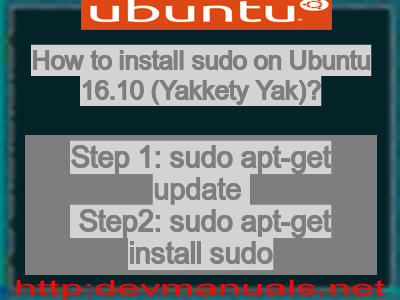
First of all update your system with the command:
sudo apt-get update
Ads
Above command will download the package lists for Ubuntu 16.10 on your system. This will update the list of newest versions of packages and its dependencies on your system.
After downloading the latest package list with the help of above you can run the installation process.
If sudo is not installed on your compter then the command 'dpkg -L sudo' will give followin error.
Installing sudo:
After system update use the following command to install sudo:
sudo apt-get install sudo
Above command will confirm before installing the package on your Ubuntu 16.10 Operating System. If you are not already logged in as su, installer will ask you the root password. After completion of the installation you can use the package on your system.
How to uninstall/remove sudo from Ubuntu 16.10?
Now we will see the commands for uninstalling the sudo from Ubuntu 16.10. For uninstalling this package you can easily use the apt command and remove the package from Linux Operating System.
To remove the sudo following command is used:
sudo apt-get remove sudo
Following command is used to remove the sudo package along with its dependencies:
sudo apt-get remove --auto-remove sudo
This will remove sudo and all its dependent packages which is no longer needed in the system.
Completely removing sudo with all configuration files:
Following command should be used with care as it deletes all the configuration files and data:
sudo apt-get purge sudo
or you can use following command also:
sudo apt-get purge --auto-remove sudo
Above command will remove all the configuration files and data associated with sudo package. You can can't recover the delete data, so, use this command with care.


